
Form 990 Intro
A guide to the Form 990’s purpose, key sections, and filing requirements.
What is the Form 990?
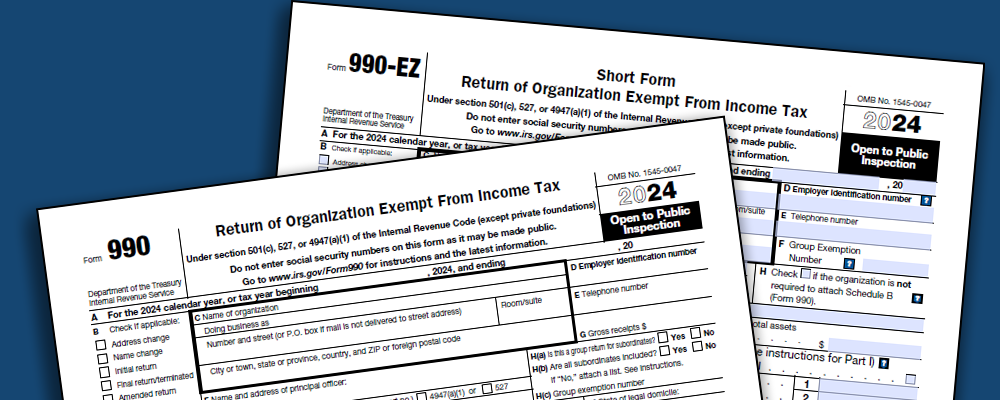
The Form 990, “Return of Organization Exempt From Income Tax,” is the primary annual information return filed by most tax-exempt organizations with the IRS. More than just a tax form, it is a public disclosure document that provides a comprehensive overview of an organization’s mission, programs, governance, and financial activities for the year. Its main purposes are to ensure compliance with tax law and to provide transparency to the public, including donors, grantmakers, and watchdog agencies.
Who is Required to File?
Generally, most organizations that are exempt from federal income tax under §501(a) are required to file a version of the Form 990. The specific version depends on the organization’s financial activity:
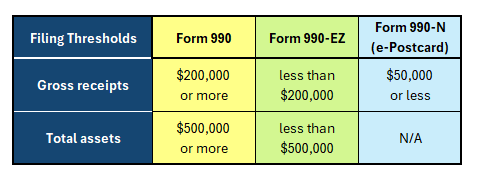
- Form 990: Typically required for organizations with gross receipts of $200,000 or more, or total assets of $500,000 or more.
- Form 990-EZ: A shorter version for mid-sized organizations, generally with gross receipts less than $200,000 and total assets less than $500,000.
- Form 990-N (e-Postcard): A simple electronic notice for most small organizations with annual gross receipts normally of $50,000 or less.
Certain organizations, such as churches and some government-affiliated entities, are exempt from this filing requirement.
When To File?

The Form 990 is due on the 15th day of the 5th month after an organization’s accounting period ends. For organizations using a calendar year-end (December 31), the deadline is May 15.
An organization can obtain an automatic six-month extension of time to file by submitting Form 8868, “Application for Extension of Time To File an Exempt Organization Return,” on or before the original due date of the return.
A Tour of the Form 990
The Form 990 is divided into several parts, each detailing a different aspect of the organization. Understanding these sections is key to grasping the full picture of a nonprofit’s operations. The core form includes:
- Heading: Captures the organization’s core identifying information.
- Part I, Summary: Provides a one-page snapshot of the organization’s mission, activities, and key financial figures.
- Part II, Signature Block: Contains the signature of an officer of the organization, as well as the section for the paid preparer’s information.
- Part III, Statement of Program Service Accomplishments: Details the organization’s mission-related activities and achievements.
- Part IV, Checklist of Required Schedules: A crucial checklist that determines which supplemental schedules must be filed.
- Part V, Statements Regarding Other IRS Filings and Tax Compliance: A series of yes/no questions related to other tax compliance and filing obligations.
- Part VI, Governance, Management, and Disclosure: Asks questions about the organization’s governing body, policies, and public disclosure practices.
- Part VII, Compensation: Reports compensation paid to officers, directors, trustees, key employees, and other highly compensated individuals.
- Part VIII, Statement of Revenue: Details the sources of the organization’s revenue for the year.
- Part IX, Statement of Functional Expenses: Allocates expenses among program services, management and general, and fundraising categories.
- Part X, Balance Sheet: Provides a snapshot of the organization’s assets, liabilities, and net assets at the end of the fiscal year.
- Part XI, Reconciliation of Net Assets: Reconciles the net assets at the beginning of the year with the net assets at the end of the year.
- Part XII, Financial Statements and Reporting: Asks questions about the organization’s accounting methods and whether it prepares audited financial statements..
Explore the Form in Detail
This introduction provides a high-level overview. To explore the specific details of the form, please return to the main hub.
About These Tools
Disclaimer: This website is for informational purposes only and does not constitute professional tax advice.
Source: The content in these tools (such as definitions, questions, and instructions) is from the official IRS Instructions for Form 990, 990-PF, and related schedules and is in the public domain. For the most current official version, please visit https://www.irs.gov/forms-pubs/about-form-990
Special Features & Notes
This is an evolving project, and feedback is always welcome. Please feel free to contact me.
To make the Glossary more user-friendly, the following enhancements have been added:
- User-Added Notes: Italicized text indicates a cross-reference added for clarity and is not part of the official IRS instructions.
- Convenience Links: References to the Internal Revenue Code (IRC) are linked to the Cornell Law School Legal Information Institute (LII) website for the full text.